io.github.primeline-ai/kairn
io.github.primeline-ai/kairn · 13 stars · Python · MIT
MCP server Local-first knowledge engine for AI agents: memory, graph, and recall over MCP.
Install
The repo has no one-line install. Follow its README.
Published as
- mcpb
https://github.com/primeline-ai/kairn/releases/download/v0.3.1/kairn-0.3.1.mcpbstdio
From the server's entry in the official MCP Registry.
Configuration
| Name | Set as | What it is |
|---|---|---|
KAIRN_WORKSPACEOptional | Env var | Directory holding the Kairn database. Everything Kairn stores stays inside it and never leaves this machine. Defaults to ~/.kairn. |
Files
Kairn
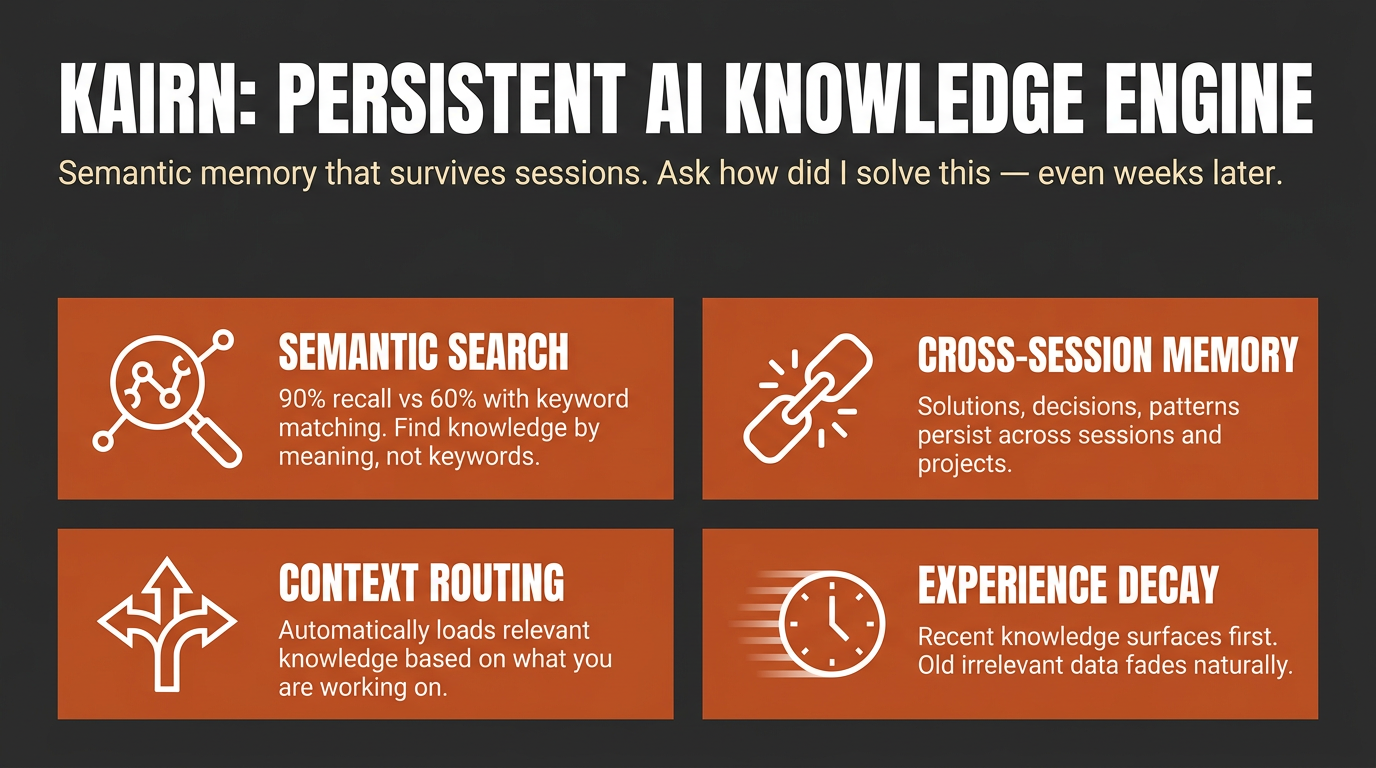
kairn-full.mp4
Context-aware knowledge engine for AI assistants.
Status: pre-1.0. In daily use since February 2026, with a test suite that runs on Linux, macOS and Windows (see Development) and a published LongMemEval-S benchmark (measured before 0.3.0). Interfaces may still change between releases until 1.0. Feedback and issues welcome.
Other tools give your AI a memory. Kairn gives it a knowledge graph with intelligent context routing. It knows what to load, when to load it, and how much - so your AI stays focused, not overwhelmed.
pip install kairn-ai
kairn init ~/brain
kairn serve ~/brain
Claude Code and Codex each take one line; --init creates ~/brain and its database on first start, so this works even without kairn init:
claude mcp add kairn -- kairn serve --init ~/brain
codex mcp add kairn -- kairn serve --init ~/brain
Or install it as a one-click bundle, no Python setup required: download the
.mcpb file from the latest release
and open it with a bundle-aware app such as Claude Desktop.
For other clients, see Quick Start below. New to Kairn? Jump to First 5 Minutes.
Install routes
| Route | Who it is for | Command |
|---|---|---|
| PyPI | anyone with Python, and every MCP client | pip install kairn-ai |
MCP Bundle (.mcpb) |
Claude Desktop and other bundle-aware apps; no Python install needed | download from Releases and open it |
| Claude Code | one line, uses the PyPI install | claude mcp add kairn -- kairn serve --init ~/brain |
| Codex | one line, uses the PyPI install | codex mcp add kairn -- kairn serve --init ~/brain |
The bundle carries no Kairn source of its own. It declares kairn-ai as a
dependency and the host resolves it with uv, so a bundle install and a
pip install run identical code. Where the database lives is configurable when
you install the bundle; it defaults to ~/.kairn and never leaves your machine.
Why Kairn?
Every AI conversation starts from scratch. Previous insights, decisions, and patterns - gone. Existing memory tools store flat key-value pairs that can't represent relationships or surface the right context at the right time.
Kairn is different:
- Context Router + Progressive Disclosure - Automatically loads relevant subgraphs based on keywords, starting with summaries and drilling into details only when needed. No other tool does this.
- Knowledge Graph with FTS5 - Not flat storage. Typed relationships (
depends-on,resolves,causes) between nodes with provenance tracking and full-text search across everything. - Experience Decay + Auto-Promotion - Experiences lose relevance over time (biological decay model). Frequently-accessed experiences auto-promote to permanent knowledge. Your AI naturally forgets what doesn't matter.
- 22 MCP Tools - Works with Claude Code, Codex, Claude Desktop, Cursor, VS Code, Windsurf, and any MCP client. Includes
kn_judgefor 5-verb relationship judgments andkn_doctorfor read-only health diagnostics. - Per-Workspace Isolation - Each workspace is its own isolated SQLite store. JWT auth and role-based access control (owner / maintainer / contributor / reader) ship for team deployments.
Quick Start
Claude Desktop
Add to ~/Library/Application Support/Claude/claude_desktop_config.json on macOS or %APPDATA%\Claude\claude_desktop_config.json on Windows:
{
  "mcpServers": {
    "kairn": {
      "command": "kairn",
      "args": ["serve", "--init", "~/brain"]
    }
  }
}
Cursor
Add to .cursor/mcp.json:
{
  "mcpServers": {
    "kairn": {
      "command": "kairn",
      "args": ["serve", "--init", "~/brain"]
    }
  }
}
VS Code
Add to .vscode/mcp.json:
{
  "servers": {
    "kairn": {
      "type": "stdio",
      "command": "kairn",
      "args": ["serve", "--init", "~/brain"]
    }
  }
}
Windsurf
Add to ~/.codeium/windsurf/mcp_config.json:
{
  "mcpServers": {
    "kairn": {
      "command": "kairn",
      "args": ["serve", "--init", "~/brain"]
    }
  }
}
Restart your editor. Kairn's 22 tools appear in the MCP section.
First 5 Minutes
A guided first run, end to end:
pip install kairn-ai
kairn init ~/brain              # creates the workspace + database (optional: serve --init does it on first start)
Add the one-liner from above (or your client's Quick Start snippet), then restart the client. Once connected, ask your assistant to remember something:
"Remember that we chose Postgres over SQLite for the analytics service because we needed concurrent writers."
That calls kn_learn under the hood and returns a JSON envelope like this (captured from a real run, via kairn learn, the CLI mirror of the tool):
{"_v": "1.0", "stored_as": "node", "node_id": "002d9c22", "experience_id": "d0710c2f", "type": "decision", "confidence": "high", "namespace": "knowledge", "candidates": []}
Start a new session and ask it to recall the same thing - that calls kn_recall and surfaces what you just stored, no re-explaining required:
{"_v": "1.0", "count": 2, "results": [
  {"source": "node", "id": "002d9c22", "name": "Decision: we chose Postgres over SQLite for the analytics service beca", "type": "learned_decision", "description": "we chose Postgres over SQLite for the analytics service because we needed concurrent writers", "relevance": 1.0, "relevance_kind": "match"},
  {"source": "experience", "id": "d0710c2f", "type": "decision", "content": "we chose Postgres over SQLite for the analytics service because we needed concurrent writers", "confidence": "high", "relevance": 1.0, "relevance_kind": "recency"}
]}
kn_learn stored both a permanent graph node and a decaying experience (high confidence does both, see Confidence routing); kn_recall found both from a three-word topic.
Read relevance_kind before you read relevance. Both rows above show 1.0 and they do not mean the same thing. match is lexical match strength (bm25); the experience's recency is time-decay - it is 1.0 because the row was created seconds ago, not because it matched well. A third value, similarity, is embedding cosine on the semantic-recall path, and unscored marks a row the surface had no ranking for and filled in with a constant. The numbers are not comparable across kinds, so do not sort a mixed result set on relevance alone. Same caution for min_relevance on kn_recall: it gates nodes on match strength and experiences on recency, one number against two scales. On kn_memories and kn_prune, which see experiences only, it is recency - and on kn_prune it deletes.
Run kairn status ~/brain any time as a smoke test - if it prints a JSON stats block (nodes/edges/experiences counts), the workspace is healthy. Want a scripted tour of every core feature instead of doing it by hand? Run kairn demo ~/brain - it walks through node creation, querying, experience saving, learning, recall, and context in about 30 seconds.
Which tool when
22 tools is a lot to hold in your head on day one. Most sessions only need these:
| You want to... | Use | Why |
|---|---|---|
| Remember something new (a decision, gotcha, pattern, solution) | kn_learn |
Default entry point - auto-routes to a permanent node (high confidence) or a decaying experience (medium/low), no need to decide yourself |
| Capture a stated user preference the moment it is expressed | kn_preference |
Dedicated preference write path - you (the calling model) state the preference as one explicit sentence; stored with the longest half-life of any type |
| Add a permanent named concept you already know is durable | kn_add |
Skips decay entirely - for structural knowledge, not day-to-day experience |
| Log a one-off experience with explicit confidence/decay control | kn_save |
Lower-level primitive kn_learn wraps - reach for it when you want to set confidence/decay yourself |
| Search the permanent knowledge graph by text, type, tags, or namespace | kn_query |
You're looking for nodes, not decaying experiences |
| Search saved experiences, ranked by relevance and decay | kn_memories |
You're looking for experience content (solutions, gotchas, workarounds), not graph nodes |
| Surface everything relevant to a topic in one call | kn_recall (flat list) or kn_context (subgraph, progressive disclosure: summary first, full detail on demand) |
You don't know yet whether the answer is a node or an experience - let Kairn search both |
Everything else (kn_crossref, kn_related, kn_connect, kn_judge, kn_project/kn_projects/kn_log, kn_idea/kn_ideas, kn_promote_pending, kn_prune, kn_remove, kn_status, kn_doctor) is advanced usage - see the full 22 Tools reference below once you're past the basics.
22 Tools (kn_ prefix)
All tools follow MCP protocol with JSON responses.
Graph (6)
| Tool | Description |
|---|---|
kn_add |
Add node to knowledge graph |
kn_connect |
Create typed edge between nodes (lax-mode vocabulary) |
kn_judge |
Record 5-verb judgment edge (strict mode: conflicts_with / supersedes / compatible / scoped / related) |
kn_query |
Search by text, type, tags, namespace |
kn_remove |
Soft-delete node or edge (undo-safe) |
kn_status |
Graph stats, health, system overview |
Project Memory (3)
| Tool | Description |
|---|---|
kn_project |
Create or update project |
kn_projects |
List projects, switch active |
kn_log |
Log progress or failure entry |
Experience Memory (5)
| Tool | Description |
|---|---|
kn_save |
Save experience with decay |
kn_preference |
Capture a stated user preference at utterance time (longest half-life) |
kn_memories |
Decay-aware experience search |
kn_prune |
Remove expired experiences |
kn_promote_pending |
Promote high-access experiences to permanent nodes |
Ideas (2)
| Tool | Description |
|---|---|
kn_idea |
Create or update idea |
kn_ideas |
List/filter ideas by status, category |
Intelligence (5)
| Tool | Description |
|---|---|
kn_learn |
Store knowledge with confidence routing |
kn_recall |
Surface relevant past knowledge |
kn_crossref |
Find similar past solutions in the current workspace |
kn_context |
Keywords → relevant subgraph with progressive disclosure |
kn_related |
Graph traversal (BFS) to find connected nodes |
Diagnostic (1)
| Tool | Description |
|---|---|
kn_doctor |
Read-only health checks (lock mode, FTS5 parity, promotion backlog, namespace sprawl, orphan edges) - returns structured envelope with per-check verdicts and roll-up summary |
Resources & Prompts
Resources (read-only context for MCP clients):
kn://status- Graph overview, active projectkn://projects- All projects with recent progresskn://memories- Recent high-relevance experiences
Prompts (session management):
kn_bootup- Load active project, recent progress, and top memories (session start)kn_review- Summarize session and suggest next steps (session end)
How It Works
Architecture
Any MCP Client (Claude, Cursor, VS Code)
        │
        ▼ MCP Protocol (stdio)
FastMCP Server (22 tools)
        │
   ┌────┼────┐
   ▼    ▼    ▼
Graph  Memory  Intelligence
Engine Engine  Layer
   │    │      │
   └────┼──────┘
        ▼
   SQLite + FTS5
   (per-workspace)
Decay Model
Experiences decrease in relevance exponentially:
relevance(t) = initial_score × e^(-decay_rate × days)
| Type | Half-life | Notes |
|---|---|---|
| solution | 120 days | Stable, durable |
| pattern | 90 days | Architectural knowledge |
| decision | 100 days | Context-dependent |
| workaround | 40 days | Temporary fixes fade fast |
| gotcha | 70 days | Tricky pitfalls stay relevant |
| preference | 180 days | Durable user preferences - initial estimate, not yet tail-calibrated |
Half-lives are calibrated against the real access tail of a production experience store, not guessed (one exception: preference is a new type with no access history yet, so its value is a documented initial estimate until real data accumulates).
Confidence routing via kn_learn:
high→ Permanent node + experience (no decay)medium→ Experience with 2× decaylow→ Experience with 4× decay- Auto-promotion: 5+ accesses → permanent node
- Node access tracking:
kn_recall,kn_context, andkn_crossreflog which nodes were accessed, feeding the decay and promotion pipeline
Benchmarks
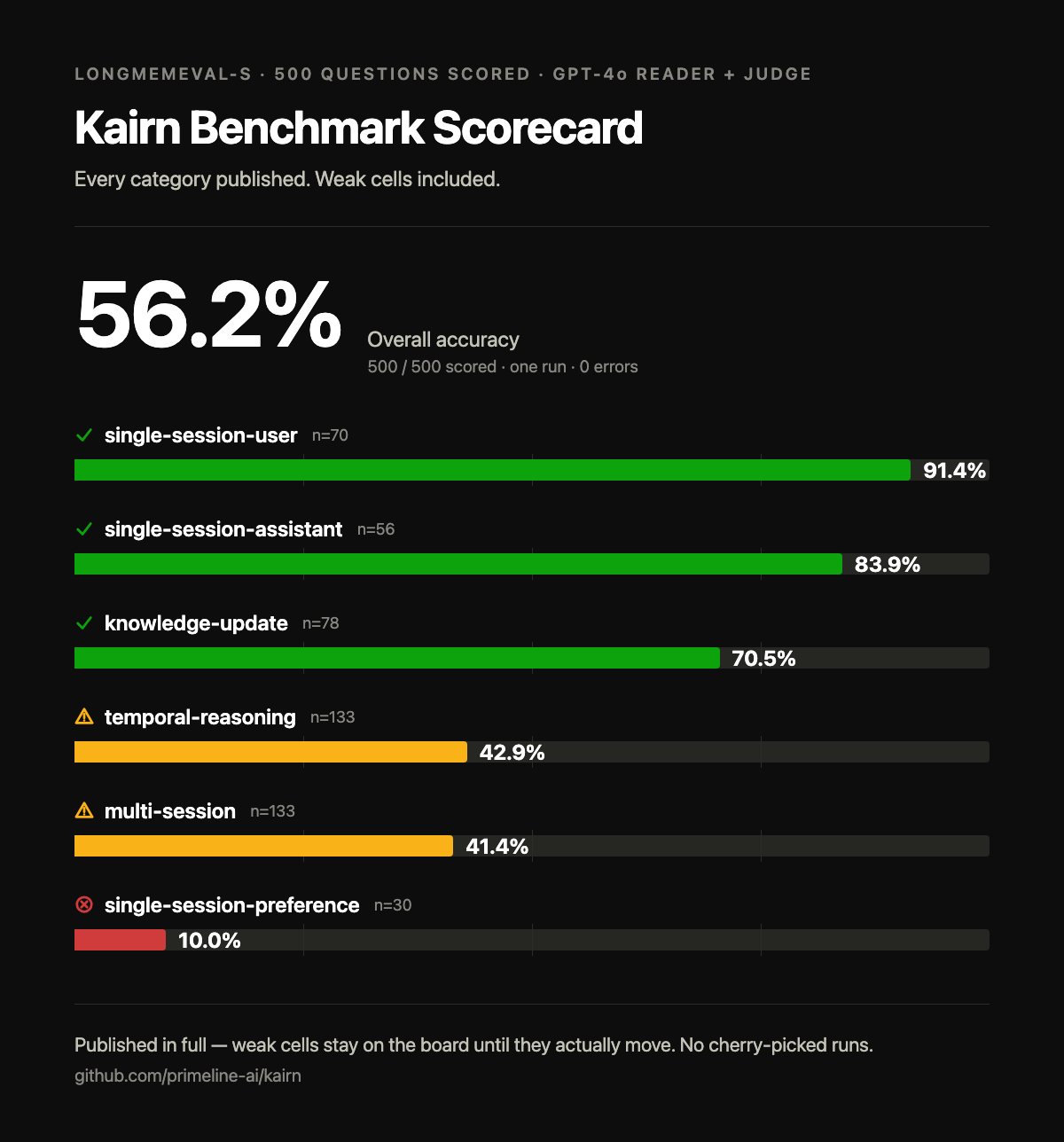
Kairn scored 56.2% overall on LongMemEval-S in the 2026-06-12 run (500/500 questions scored, GPT-4o reader + judge, single run, 0 errors). These are the real per-category numbers, including the bad ones - each red cell links to its diagnosis:
| Category | n | Accuracy | Diagnosis |
|---|---|---|---|
| single-session-user | 70 | 91.4% | - |
| single-session-assistant | 56 | 83.9% | - |
| knowledge-update | 78 | 70.5% | - |
| temporal-reasoning | 133 | 42.9% | why |
| multi-session | 133 | 41.4% | why |
| single-session-preference | 30 | 10.0% | why |
The 500 questions include 30 abstention variants (the right answer is to decline); they are counted inside their categories above and scored separately: Kairn declines correctly on 96.7% of them.
Recall latency was ~1.4 ms per query in that run (FTS5, in-process, no network). Protocol, honesty notes, and reproduction steps: BENCHMARKS.md.
These numbers were measured on 2026-06-12, before the recall changes in 0.3.0 (match-aware experience scoring, coverage-weighted node relevance), and have not been re-measured on 0.3.0 yet. A weak cell stays on the board until the number actually moves. No cherry-picked runs, no hidden categories.
CLI
kairn init [<path>]            # Initialize workspace; defaults to ~/.kairn
kairn serve [<path>]           # Start MCP server (stdio); defaults to ~/.kairn
kairn serve --init [<path>]    # Create workspace if needed and start MCP server; defaults to ~/.kairn
kairn status <path>            # Graph stats
kairn demo <path>              # Interactive tutorial
kairn benchmark <path>         # Local performance benchmarks (latency, not LongMemEval)
kairn token-audit <path>       # Audit tool token usage
kairn import git <path> <repo>...  # Import git commit history (zero-LLM, offline)
kairn import claude-code <path>    # Import Claude Code session history (zero-LLM, offline)
Importing your history
kairn import git <workspace> <repo>... backfills a Kairn store from one or
more local git repositories at $0 - no LLM calls, no network calls. Conventional-commit
prefixes map to experience types (fix: -> solution, feat:/refactor:/perf: -> pattern,
everything else -> decision); merge commits are skipped. Imported experiences land in a
dedicated imported-git namespace, separate from your organic knowledge, so they're always
distinguishable and a bad import is fully reversible.
kairn import git ~/brain ~/code/my-project --dry-run   # Preview first
kairn import git ~/brain ~/code/my-project              # Then import for real
kairn import git ~/brain ~/code/proj-a ~/code/proj-b --since 2026-01-01
Idempotent - re-running only imports commits that weren't already imported, so it's safe to run again as a repo's history grows.
Claude Code transcripts
kairn import claude-code <workspace> backfills your Kairn store from your existing
Claude Code session history, also at $0 and fully offline. With no --root given it scans
~/.claude/projects; --root PATH is a repeatable override for any other folder. Imported experiences land in their own
imported-claude-code namespace, so they stay distinct from your organic knowledge and a
bad import is reversible.
kairn import claude-code ~/brain --dry-run              # Review exactly what would be stored
kairn import claude-code ~/brain                        # Import (prompts once before writing)
kairn import claude-code ~/brain --root ~/other/projects --since 2026-01-01 --yes
What gets stored (coarse mode): one experience per session - the session's title plus
your first prompt of that session. This is deliberately a low-detail, high-precision summary
rather than a fine-grained per-decision extraction: a zero-LLM rule-based extractor cannot
reliably tell a captured decision from ordinary planning chatter, so import claude-code
imports a clean session-level pointer instead of noisy fragments. It is not a full transcript
archive, and it is not a one-time migration - it is idempotent and meant to be re-run as your
history grows.
Privacy. Every stored string is passed through a deterministic secret redactor first
(API keys, Authorization/Bearer headers, password=/token=/secret= assignments,
common vendor key shapes, private-key blocks, URL-embedded credentials). Tool outputs and
tool-call blocks are never read, only your own prompt text. The redactor is defense in depth,
not the only control: a real (non-dry-run) run is gated behind an explicit confirmation, and
--dry-run shows you the exact post-redaction text before anything is written. Redaction is
bounded by its rule set, so --dry-run review before a first real import is recommended;
nothing ever leaves your machine.
Install as a plugin
The plugin needs uv.
Claude Code:
claude plugin marketplace add primeline-ai/kairn
claude plugin install kairn@kairn
Codex:
codex plugin marketplace add primeline-ai/kairn
codex plugin add kairn@kairn
If you already added Kairn with claude mcp add kairn or codex mcp add kairn, remove that entry first with claude mcp remove kairn or codex mcp remove kairn, or keep only one installation route, because both use the name kairn.
See the plugin README for what it does and the codex exec approval note.
Configuration
KAIRN_WORKSPACE=~/brain               # Sets where config.yaml is read from and where 'kairn workspace' keeps team data; 'kairn serve' opens the store at the given path, or ~/.kairn without one, regardless of KAIRN_WORKSPACE
KAIRN_JWT_SECRET=<your-secret>        # Required for team features
KAIRN_LOG_LEVEL=WARNING               # Level of Kairn's log lines on stderr: DEBUG, INFO, WARNING, ERROR or CRITICAL; default INFO; overrides log_level in config.yaml
Settings live in <workspace>/config.yaml; kairn init writes it and serve --init does not, so create it by hand if you started with serve --init. Without it the defaults apply. Semantic recall is opt-in and off by default. It reranks recall with embeddings from a local Ollama server, so stored content never leaves your machine.
semantic_recall: true
embedding_model: bge-m3                 # ollama pull bge-m3
embedding_host: http://localhost:11434
semantic_recall_floor: 0.5              # cosine floor below which semantic recall abstains
semantic_recall_top_n: 30               # keyword candidates reranked by embeddings
experience_min_match: 0.0              # match floor for experience recall, 0.0-1.0; 0 turns it off
Development
git clone https://github.com/primeline-ai/kairn
cd kairn
pip install -e ".[dev,team]"
pytest tests/ -v --cov
ruff check src/ && ruff format src/
Project Structure
src/kairn/
├── server.py              # FastMCP server + 22 tools
├── cli.py                 # CLI commands
├── config.py              # Configuration
├── core/
│   ├── graph.py           # GraphEngine (6 tools)
│   ├── memory.py          # ProjectMemory (3 tools)
│   ├── experience.py      # ExperienceEngine (4 tools)
│   ├── ideas.py           # IdeaEngine (2 tools)
│   ├── intelligence.py    # IntelligenceLayer (5 tools)
│   └── router.py          # ContextRouter
├── storage/
│   ├── base.py            # Storage interface
│   └── sqlite_store.py    # SQLite + FTS5 implementation
├── models/                # Data models
├── events/                # Event bus
└── auth/                  # JWT + RBAC (team feature)
Performance
Measure it yourself rather than trusting this table:
kairn benchmark ~/brain --nodes 100
One run of that command, 100 nodes, on an Apple M4 Pro:
| Operation | Measured |
|---|---|
| Insert | 0.7ms per node (1,479 ops/sec) |
| FTS5 query | 0.2ms (5,552 ops/sec) |
| Graph traversal | 6.0ms (166 ops/sec) |
Single run on one machine, so treat it as a shape rather than a spec - which is
why the command is above the table. kn_connect and kn_crossref used to
appear here with figures the benchmark does not produce; they have been removed
rather than estimated.
Used By
| Project | What It Uses Kairn For |
|---|---|
| Quantum Lens | Persistent insight storage, cross-analysis pattern tracking, lens effectiveness metrics |
| Claude Code Starter System | Session memory, project state, learning persistence |
License
MIT
Part of the PrimeLine Ecosystem
| Tool | What It Does | Deep Dive |
|---|---|---|
| Evolving Lite | Self-improving Claude Code plugin - memory, delegation, self-correction | Blog |
| Kairn | Persistent knowledge graph with context routing for AI | Blog |
| tmux Orchestration | Parallel Claude Code sessions with heartbeat monitoring | Blog |
| UPF | 3-stage planning with adversarial hardening | Blog |
| Quantum Lens | 7 cognitive lenses for multi-perspective analysis | Blog |
| PrimeLine Skills | 5 production-grade workflow skills for Claude Code | Blog |
| Starter System | Lightweight session memory and handoffs | Blog |
Facts
- Kind
- MCP server
- Group
- Uncategorized
- Stars
- 13
- License
- MIT
- Language
- Python
- Last push
- 2026-10-11
- Forks
- 3
- MCP Registry
- io.github.primeline-ai/kairn
- Homepage
- primeline.cc
- Topics
- ai-agents, ai-memory, claude-code, developer-tools, knowledge-graph, llm-tools, mcp
- 1REAio.github.morluto/reaReverse engineer anything from your terminal or agent with one CLI and MCP server.125.3k
- 2com.browser-use/browser-usecom.browser-use/browser-useControl a real Chrome browser to complete any task: fill forms, extract data, book flights.117.7k
- 3World Monitorapp.worldmonitor/mcpLive markets, conflicts, country risk, chokepoints, energy, and China decision signals. 93 tools.88.3k
- 4Scrapling MCP Serverd4vinci/scrapling🕷️ An adaptive Web Scraping framework that handles everything from a single request to a full-scale crawl! Don't be shy, join here: https://discord.gg/EMgGbDceNQ and follow here for daily tips and tricks: https://x.com/Scraplingdev86.9k
- 5Everythingmodelcontextprotocol/serversThis MCP server attempts to exercise all the features of the MCP protocol. It is not intended to be a useful server, but rather a test server for builders of MCP clients. It implements prompts, tools, resources, sampling, and more to showcase MCP capabilities.85.8k
- 6Fetchmodelcontextprotocol/serversA Model Context Protocol server that provides web content fetching capabilities. This server enables LLMs to retrieve and process content from web pages, converting HTML to markdown for easier consumption.85.8k


