kalil0321/reverse-api-engineer
kalil0321/reverse-api-engineer
Marketplace The agent that turns websites into APIs!
No marketplace file This repo has no .claude-plugin/marketplace.json at its root, so /plugin marketplace add stops with an error. It ships plugins for OpenClaw or another agent instead.
Install
The repo has no one-line install. Follow its README.
Files

Reverse API Engineer
Turn websites into APIs. Browse (or let an agent browse), and get a clean, typed client for the endpoints the site actually uses.
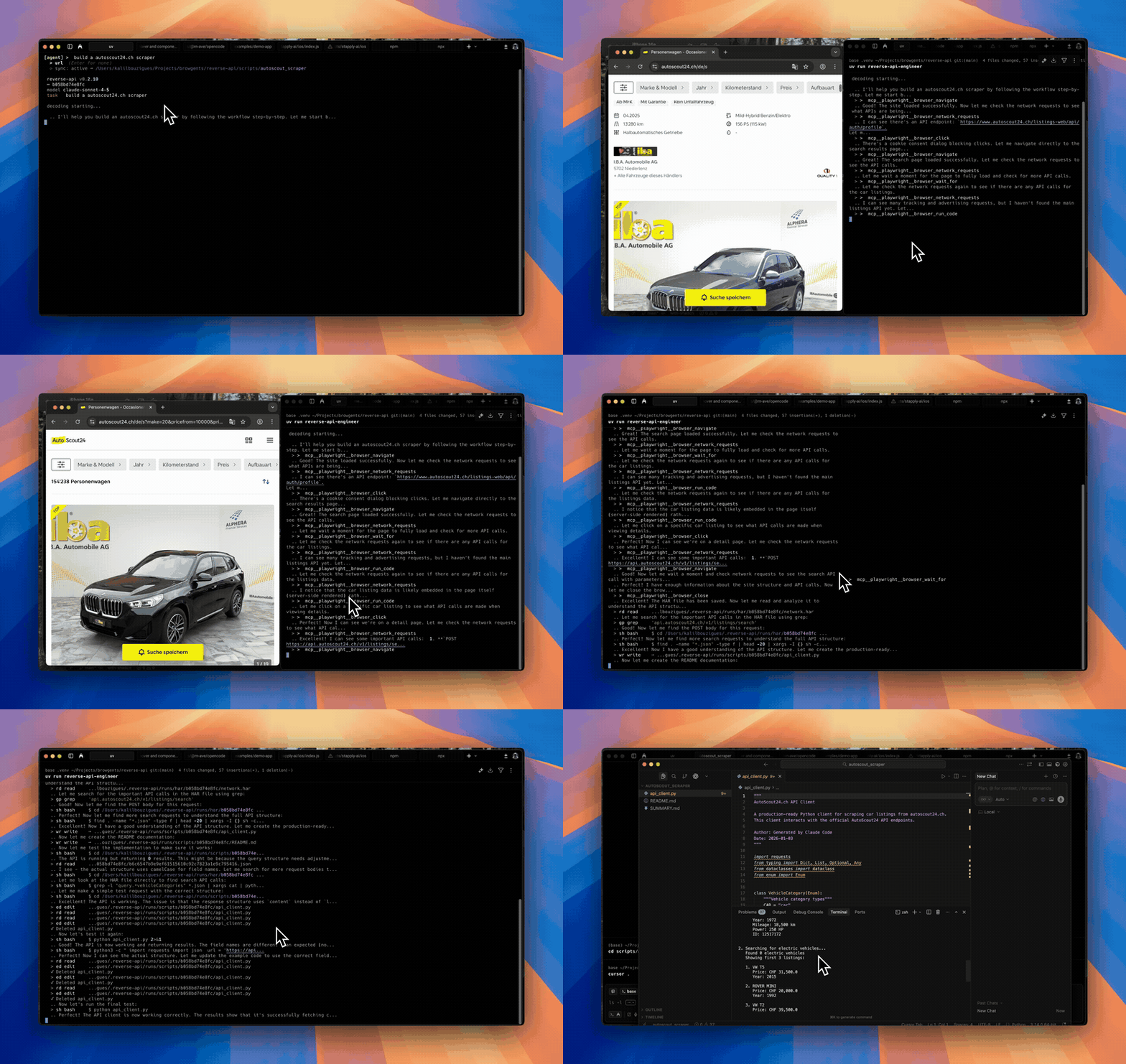
Agent mode
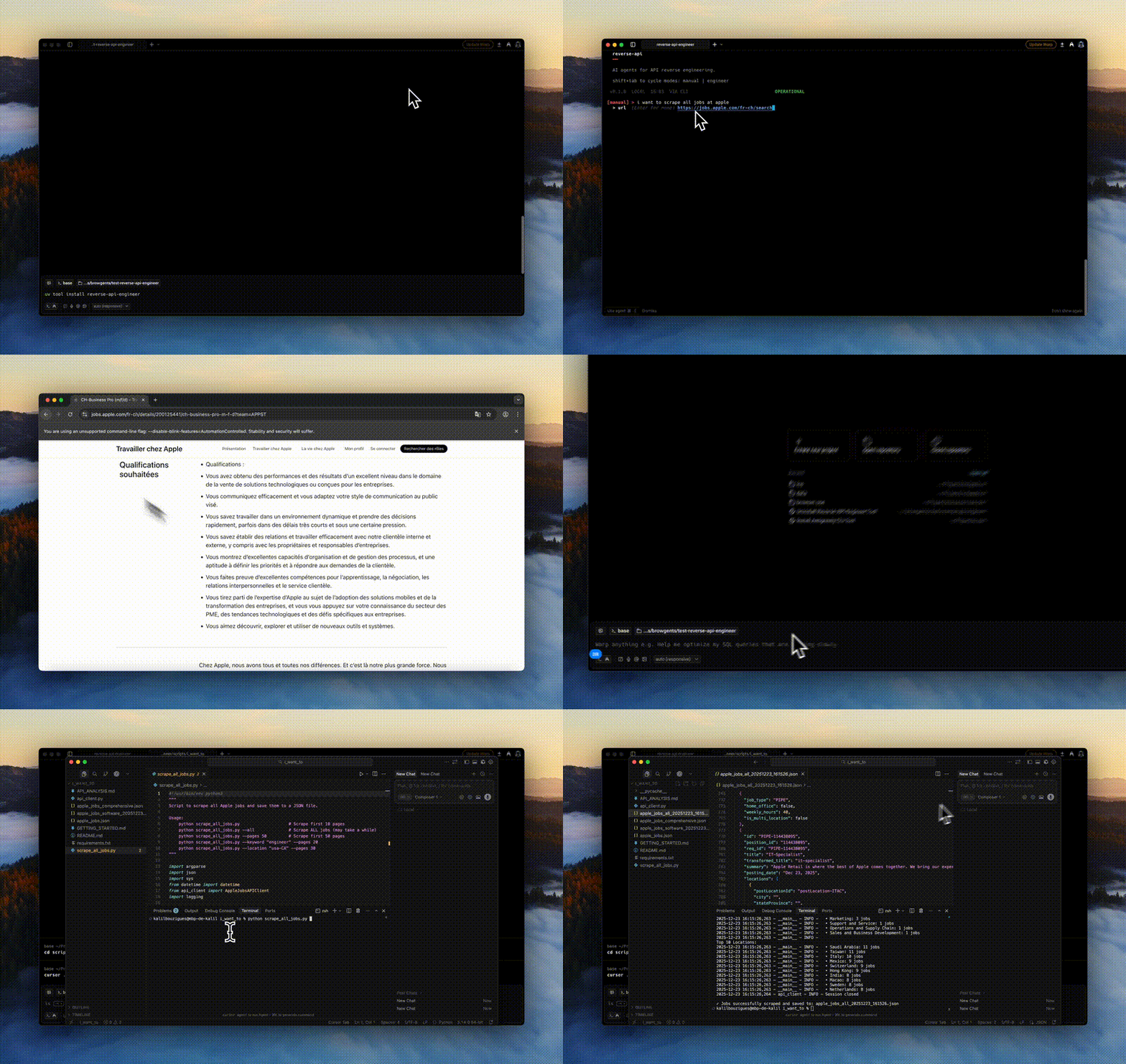
Manual mode
How it works
- You give it a website and a goal ("fetch all Apple jobs").
- A browser visits the site, either driven by you or by an AI agent.
- Network traffic is captured to a HAR file.
- Your configured model reads the traffic and writes a working API client in Python, JavaScript, TypeScript, Go, Java, C#, PHP, Ruby, C, or PowerShell.
No more manually opening DevTools, copying cURL commands, and gluing together a client.
Install
uv tool install reverse-api-engineer # or: pip install reverse-api-engineerThe secured cryptography dependency no longer supports Intel macOS or 32-bit Windows. Use Linux (including on Intel hardware), Apple Silicon macOS, or 64-bit Windows. Installing on the retired platforms may attempt an unsupported source build requiring Rust and OpenSSL development tools; this is not a supported installation path. Do not downgrade cryptography to restore old wheels. See the upstream platform changes.
Agent mode (the default) captures through npx-launched browser tooling —
browser MCP servers (Playwright or Chrome DevTools) or the Vercel agent-browser
CLI — and needs no extra Python packages. Manual mode drives a local
Playwright browser, which ships in the optional [manual] extra:
uv tool install "reverse-api-engineer[manual]"   # or: pip install "reverse-api-engineer[manual]"
playwright install chromium
Quick start
reverse-api-engineer
> fetch all apple jobs from their careers page

# Browser opens. Navigate, interact, close when done.
# → ./scripts/apple_jobs_api/  (api_client.py, README.md, example_usage.py)
Cycle modes with Shift+Tab:
| Mode | What it does |
|---|---|
manual |
You drive the browser; AI generates the client from captured traffic. |
agent |
An AI agent drives capture autonomously (Playwright or Chrome MCP, or Vercel agent-browser CLI). |
engineer |
Re-run generation on a previous capture (engineer <run_id>). |
collector |
Agent collects structured data (JSON/CSV) using web search + fetch. |
Agent mode providers:
- auto (default): Playwright MCP, single workflow for browsing + reverse engineering.
- chrome-mcp: drives your real Chrome so you keep existing sessions/cookies. Requires Chrome 146+ and Node.js 20.19+.
- agent-browser: Vercel agent-browser CLI (not a Reverse API Engineer browser MCP server). At session start RAE uses whatever
agent-browseris already onPATH, otherwise runsnpm install -g <pin>(same pin as config /RAE_AGENT_BROWSER_PACKAGE), prints a yellow notice, validates with--help, and only then falls back tonpx -y <pin>if npm cannot install. Prompts embed the resolved shell prefix alongsideskills get core --full,skills list, HAR phases, cloud notes fromagent_browser_notes. Tune withagent_browser_npx_package(optional), envRAE_AGENT_BROWSER_*. First Chromium fetch:agent-browser install(add--with-depson trimmed Linux).
Optional sanity checks:
agent-browser doctor --offline --quick || true
agent-browser skills list >/dev/null
Configuration
Settings live in ~/.reverse-api/config.json and can be edited via /settings in the CLI:
{
  "agent_provider": "auto",
  "agent_browser_npx_package": "agent-browser@0",
  "agent_browser_notes": "",
  "claude_code_model": "claude-sonnet-4-6",
  "collector_model": "claude-sonnet-4-6",
  "ollama_auto_start": true,
  "ollama_base_url": "http://127.0.0.1:11434",
  "opencode_auto_start": true,
  "opencode_base_url": "http://127.0.0.1:4096",
  "opencode_model": "big-pickle",
  "opencode_npx_package": "opencode-ai@latest",
  "opencode_provider": "opencode",
  "copilot_model": "gpt-5",
  "cursor_model": "composer-2.5",
  "output_dir": null,
  "output_language": "python",
  "real_time_sync": true,
  "sdk": "claude"
}- Models: Sonnet 4.6 (default), Opus 4.6 (most capable), Haiku 4.5 (fastest). For OpenCode see models.dev.
- SDK:
claude(default),opencode,cursor, orcopilot(GitHub Copilot). - OpenCode setup: with
sdk: "opencode", RAE reuses an existing server or downloads/startsopencode-ai@latestthroughnpx; a global OpenCode installation is not required. Fresh configurations default to the freeopencode/big-picklemodel./settingsshows a loading spinner, then offers a searchable OpenCode Provider / Model picker populated from the server's connected, tool-capable catalog and marks free OpenCode options. Before creating a session, RAE validates the saved pair again and suggests currently available free models when configuration is invalid. Compatible older servers are reused with a version warning. Node.js 20+ is required for automatic startup. Password-protected servers useOPENCODE_SERVER_PASSWORDand optionalOPENCODE_SERVER_USERNAME. Override startup withOPENCODE_BASE_URL,RAE_OPENCODE_PACKAGE, orRAE_OPENCODE_AUTO_START=0. - Ollama through OpenCode: choose provider
ollamain/settings; RAE starts an installed Ollama daemon if needed, lists only installed models with tool calling and 64k+ context, and supplies OpenCode's provider config inline. Models are never downloaded silently. Override withRAE_OLLAMA_BASE_URLorRAE_OLLAMA_AUTO_START=0. - Output language:
python,javascript,typescript,go,java,csharp,php,ruby,c, orpowershell. C needs a POSIX toolchain (cc, libcurl headers) — macOS/Linux, or WSL/MSYS2 on Windows. PowerShell needspwsh7+ (PowerShell Core, not Windows PowerShell 5.1). Its runner executes the generatedExample.ps1besideapi_client.psm1; argument overrides are not supported. Edit the example or import the module to call its exported functions with your own arguments.
CLI
Slash commands inside the CLI:
/settings: configure model, SDK, agent provider, and sync settings./history: list past runs with timestamps, costs, and status./messages <run_id>: view detailed message logs for a run./help(alias:/commands): show the command list./exit(alias:/quit): leave the CLI.
Scriptable subcommands (pipe to jq):
reverse-api-engineer agent --prompt "capture the public jobs api" \
  --url https://example.com/jobs --json | jq

reverse-api-engineer list --json
reverse-api-engineer show <run_id> --json
reverse-api-engineer run <run_id> --file api_client.py \
  --no-interactive --auto-install -- --org acme
Pass --no-interactive (and/or --json) to skip prompts. With --json, stdout is one JSON document and logs go to stderr.
agent --json schema
| Field | Type | Notes |
|---|---|---|
schema_version |
int |
Currently 1. |
status |
"ok" | "error" |
Top-level result. |
run_id |
string | null |
Use with show / engineer / run. |
prompt |
string |
|
url |
string | null |
|
mode |
string | null |
"auto", "chrome-mcp", or "agent-browser". |
har_path |
string | null |
Captured HAR. |
script_path |
string | null |
Generated client. |
usage |
object |
{input_tokens, output_tokens, total_cost}. |
error |
string | null |
When status == "error". |
Exit codes
| Code | Meaning |
|---|---|
0 |
Success. |
1 |
Runtime error. |
2 |
Missing required arg under --no-interactive / --json. |
For run, the exit code is the underlying script's return code on success, 1 if no script was found, or non-zero if --no-interactive would have had to prompt.
Debugging agent failures
Set the RAE_DEBUG environment variable to 1 to print the Python traceback
for unexpected agent capture failures to stderr. Normal error messages remain
concise by default, and --json / --json-stream stdout remains machine-readable.
Output locations
~/.reverse-api/runs/scripts/{run_id}/: permanent storage./scripts/{descriptive_name}/: local copy with a readable name- Collector:
./collected/{folder_name}/(items.json,items.csv,README.md)
Caveats
- Generated code runs locally via Claude Code, so review before executing.
- Sites with aggressive bot detection may block capture or require manual interaction.
Development
git clone https://github.com/kalil0321/reverse-api-engineer.git
cd reverse-api-engineer
uv sync
uv run reverse-api-engineer
Build: ./scripts/clean_build.sh. Requires Python 3.11+ and an API key for agent mode. Manual mode additionally needs the [manual] extra plus playwright install chromium.
License
MIT. See LICENSE.
Facts
- Kind
- Marketplace
- Repo
- kalil0321/reverse-api-engineer
- Group
- Uncategorized
- License
- MIT
- Language
- Python
- Created
- 2025-12-23
- Forks
- 114
- Homepage
- reverseapi.dev
- Topics
- ai, ai-agents, claude, cli, mcp, openapi, playwright, scraping, web-scraping
- Plugins
- 1
- 1f/prompts.chatf/prompts.chatf.k.a. Awesome ChatGPT Prompts. Share, discover, and collect prompts from the community. Free and open source — self-host for your organization with complete privacy.
- 2affaan-m/everything-claude-codeaffaan-m/everything-claude-codeThe agent harness performance optimization system. Skills, instincts, memory, security, and research-first development for Claude Code, Codex, Opencode, Cursor and beyond.
- 3obra/superpowersobra/superpowersAn agentic skills framework & software development methodology that works.
- 4anthropics/skillsanthropics/skillsPublic repository for Agent Skills
- 5anthropics/claude-codeanthropics/claude-codeClaude Code is an agentic coding tool that lives in your terminal, understands your codebase, and helps you code faster by executing routine tasks, explaining complex code, and handling git workflows - all through natural language commands.
- 6nextlevelbuilder/ui-ux-pro-max-skillnextlevelbuilder/ui-ux-pro-max-skillAn AI skill that provides design intelligence for building professional UI/UX across multiple platforms.


